- Tactical Tips by DECODE
- Posts
- 🚀 How to survive AI competition?
🚀 How to survive AI competition?
3 tactics, 2 traps and 1 tool to survive AI competition

DECODE
April 01, 2026
Welcome back to ‘Tactical Tips’ by Jerel and Shuo at DECODE, the largest founder community co-hosted across Berkeley and Stanford. Every week, we cover one of our founders’ top questions on how to build, sell and operate 10x better.
Today, our previous issues on finding competitive advantages, we’ll be answering the question, “How to survive AI competition?” and covering insights around mapping competitive pressure, going deep on domain, and building trust.
So, here is advice inspired by Evan Tana, General Partner at South Park Commons and Victoria Zuo, Partner at QED Investors.
And ... we’ve curated a YouTube playlist featuring our best founders, operators and investors.
🔥 Inside this issue:
✅ 3 tactics to survive AI competition
✅ 2 traps to avoid
✅ 1 tool to leverage
👇Let’s dive in.
Grab 30 mins with Jerel - Need personalized advice on building your startup or just want to talk? Happy to help and make intros if it’s the right fit.
💌Someone shared this with you? Subscribe here.
3 tactics to survive AI competition
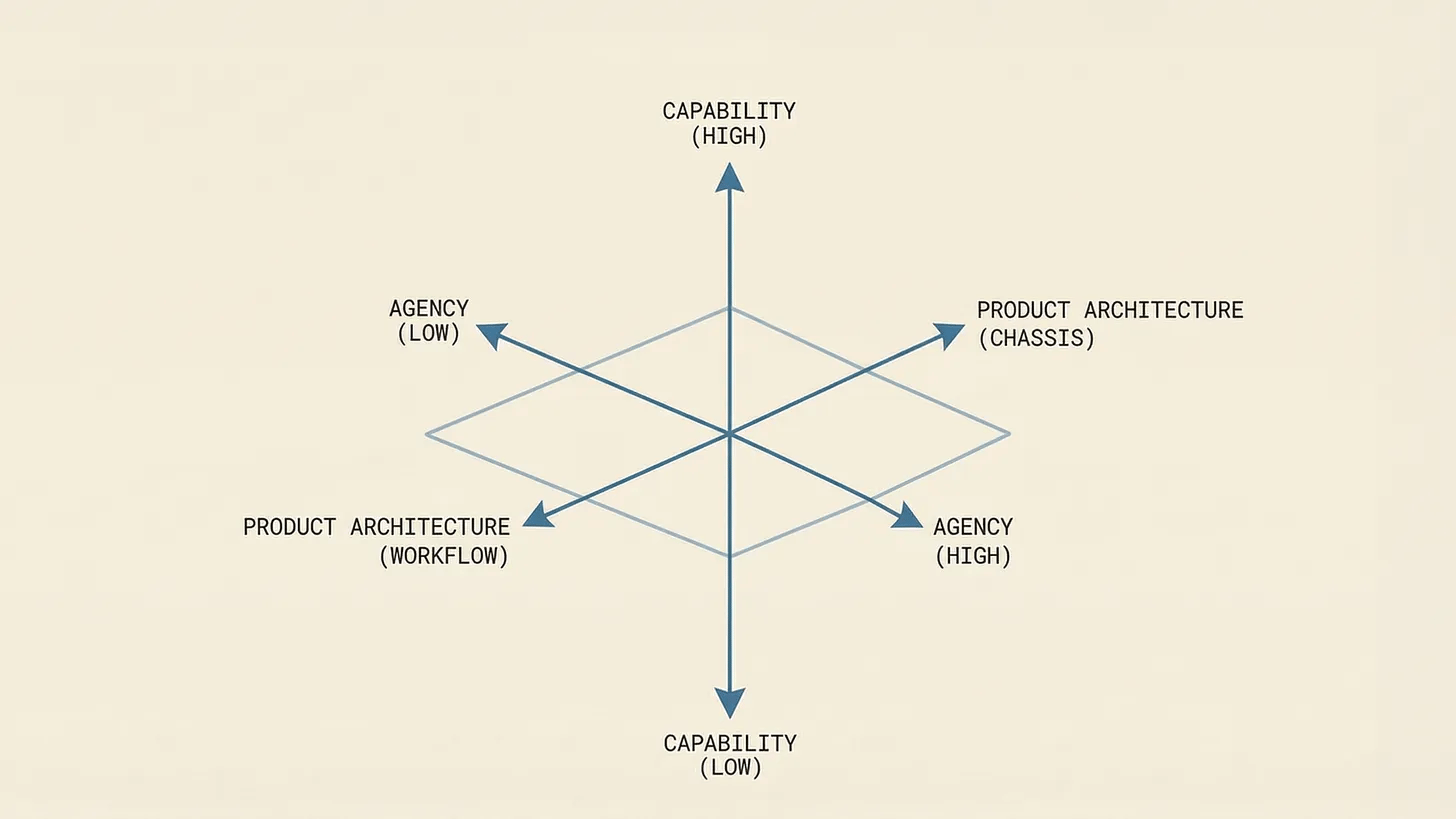
📍 Map competitive pressure across 4 fronts
Find your competitive advantage
Analyze and evaluate incumbents, other startups, foundation model labs, and customers across:
Capability: Can they actually wield the new AI tools you are building?
Agency: Are they empowered to build a similar product?
Understand your product architecture: Is the product primarily workflow or chassis?
Workflow = interface layer where users interact to complete tasks
Chassis = infrastructure layer like data, security, orchestration, identity and access, compute, deployment
High-capability, high-agency buyers + workflow-heavy product = strong risk of in-house replacement
Focus on building chassis products or workflows that are too embedded to rip out; move from being a workflow tool to being the operating system of the business
🎯 Go deep on domain expertise
Find industries that deliver goods and services (e.g. legal, healthcare, energy, agriculture, construction, physical distribution) or solve human problems (e.g. selling, trust, compliance, network effects, community)
AI labs ship fast, but tend to avoid these as they have low technical capability and low agency
The edge is getting closest to the user to drive discovery, purchase, and adoption:
Use licensed or proprietary data (80% of the world’s data is private)
Build data loops your users create as they use the product (personalization)
Create network effects that compound with every additional user
Drive behavior change when users try it
Build products that understand the customer, the workflow, and the problem better than any other competitors:
Know how work actually happens step-by-step (including inputs, outputs, dependencies, compliance needs, etc) and implications of that work
Translate domain-specific context into actions (eg. updating systems, generating documentation, triggering follow-ups)
E.g. AI assistant for financial advisors must go beyond transcription; it should recognize specific concepts like "Roth conversion ladders" and trigger CRM updates, compliance documentation, and follow-up tasks
Ask yourself: If every domain expert (e.g. lawyer, nurse, contractor, etc) is a software engineer, what would you build that they would need?
🤝 Build trust by shipping right, not just fast
Brand trust from customers who can’t afford to get it wrong = hard to replicate
Choose accuracy over speed, and honesty over hype
Avoid chasing competitor announcements or feature parity with half-baked releases; they don’t work well most of the time
Be transparent and clearly define capability boundaries; state what works, what doesn’t, when humans should step in, and other limitations
Show real performance numbers and avoid inflated claims, vague roadmaps, and cherry-picked demos
Hold back unfinished features and say no to poor-fit customers
2 traps to avoid
🚨 Treating build speed as a competitive advantage
Everyone can build fast now; speed is table stakes, not differentiation
Old playbook of building something cool, raise money and figure out the hard stuff and strategy later is over
Be intentional from Day 1 on who you’re building for, what to build and why
🚨 Building around current model weaknesses
Models improve non-linearly; what’s hard now will be easy soon
Products anchored in today’s model gaps will be obsolete tomorrow
Assume that models will eventually do everything; build products that gets stronger as models improve
1 tool to leverage
📖 Best practice on staying competitive
Startups and mid-market tech companies are the most dangerous ICP in 2026
Internal teams are building their own versions of workflow tools they used to pay for
Features that took a team of 10 engineers six months to ship can now be prototyped in a weekend
Leverage this Claude skill to find your competitive advantage and map competitive pressure
Bonus: 1 trend to spark startup ideas
88% resolved. 22% loyal. Your stack has a problem.

Those numbers aren't a CX issue — they're a design issue. Gladly's 2026 Customer Expectations Report breaks down exactly where AI-powered service loses customers, and what the architecture of loyalty-driven CX actually looks like.
Get more involved ❤️
Continue learning 🎓
How to build
How to sell
How to operate:
Other resources 📚
Learn more about the latest trends in startups/tech/venture
Access our crowdsourced Founders’ Prompt Library to build faster
Apply to participate in Founders Pop-up Board Advisory and receive startup feedback from execs at Google, Microsoft, Meta, Reddit
Schedule for a free consultation on structuring your equity-based compensation plan
Fill this form and we’ll get in touch for details on how we can get your brand in front of our community
Kickstart your idea 💡
Still figuring out your startup idea?Take our free course ― Zero to Startup: How to Identify a Winning Idea Fast, where you’ll receive 1 email per day over 5 days to help you get started! |
Help us improve 🌱
What did you think of today's content?Your feedback helps us improve. |
Please complete this 2-min survey to help us get to know you and better tailor content for you.
“Reply” with any follow-up questions you might have, and we’ll work on covering them in a future newsletter!
Stay tuned for more startup wisdom in next week’s edition!