- Tactical Tips by DECODE
- Posts
- 🚀 AI is making organizations flatter
🚀 AI is making organizations flatter
3 trends, 2 theses and 1 tool

DECODE
June 17, 2026
Welcome back to ‘Tactical Tips’ by Jerel and Shuo at DECODE, the largest founder community co-hosted across Berkeley and Stanford.
We've updated our rhythm to bring you higher-signal content. We’ll be landing in your inbox twice a month, alternating between one of our founders’ top questions on how to build, sell and operate 10x better, and trends on what’s new and next in startups and tech to keep you ahead of the curve.
Today, we’ll be covering trends in org structure, job scopes, impact of layoffs, and more.
And ... we’ve curated a YouTube playlist featuring our best founders, operators and investors.
🔥 Inside this issue:
✅ 3 trends in startups/tech/venture
✅ 2 theses on what’s next
✅ 1 tool to love
👇Let’s dive in.
Grab 30 mins with Jerel - Need personalized advice on building your startup or just want to talk? Happy to help and make intros if it’s the right fit.
💌Someone shared this with you? Subscribe here.
3 trends in startups/tech/venture
📈 Engineers are increasingly becoming resource allocators
Historically, the division of labor in technology was clear: engineers built, and business operations optimized. In the AI era, that line has vanished.
Today, engineers aren't just builders; they are optimizers. Startups can no longer afford to focus purely on coding now and optimizing later.
Because AI demands massive amounts of compute (processing power, memory, networking, storage etc), engineers must weave resource and process optimization into the very first lines of code they write.
🤖 AI is making organizations flatter
Jensen Huang (CEO of Nvidia, the leading AI company and the most valuable company in the world) recently shared that he has a whopping 60 people directly reporting to him. His rationale? The era of AI requires a more coordinated effort, which requires breaking down barriers to communication.
Nvidia is not alone in keeping as flat of a hierarchy as possible. In fact, both OpenAI and Anthropic now have a record number of executives who are individual contributors. This is a phenomenon that’s nearly unheard of among old guard companies.
We had the opportunity to discuss AI’s impact on organizational structures with KC, OpenAI’s Chief People Officer. You can find the video of our conversation here.

The 2 Things OpenAI’s Chief People Officer Looks For in Every Hire
💰 Investors are penalizing companies that blame AI for layoffs
Recent data shows that 56% of public companies citing AI as their primary layoff driver traded in the red post-announcement, with their stocks tumbling an average of 25%.
This trend extends beyond public markets. A Gartner survey of 350 executives found that firms cutting heads to make room for AI failed to generate higher returns than those that maintained their headcount.
The clear winners? Companies using AI for “people amplification” and boosting employee productivity rather than replacing humans outright.
2 theses on what’s next
🤖 3 types of jobs are (still) safe from AI (for now)
As more tasks and workflows are getting assigned to AI agents over humans, 3 key roles are emerging as ones that still remain critical for a human to take on:
1. Builders and systems architects (i.e., people deciding what to build and how to build it with judgment and taste)
2. Relationship experts (i.e., people who know people who can get things done)
3. Validators and context carriers (i.e., people who know why things are the way they are)
🤔 Startups need a minimum viable number of employees to be resilient
As more companies are wrestling with the optimal ratio of AI agents to people, another critical number is getting overlooked: the minimal number of humans for an organization to be resilient.
Consider two startups: Startup A and Startup B. Startup A employs 10 people. Startup B employs 3 people who in turn run 10 autonomous agents. When 1 person leaves Startup A, that’s a 10% headcount loss. When 1 person leaves Startup B, that’s a 33% headcount loss. While Startup A has 9 people left to absorb the shock, Startup B only has 2 people left, leading to a serious loss of institutional memory and relationships.
So, what’s the magic number of employees that's considered “minimally viable” in the age of AI? We’re about to find out.
1 tool we love
🎓 AI assistant for therapists
Doctors have assistants. Lawyers have paralegals. Why do therapists work alone? Therapists do some of the most emotionally taxing work on the planet, yet they are often the least supported when it comes to the "heavy lifting" of administration and documentation.
We see this firsthand with Shuo serving as a voting Commissioner on California's Mental Health Commission. Mental health is a global problem where every therapist, in every country, runs into the same wall: they're alone with the work no one trained them for.
Klarify uses AI to empower therapists, not replace them. Klarify handles every job a therapist does other than the therapy itself: clinical notes, treatment plans, insurance claims, patient follow-ups between therapy sessions, and new client acquisition. In supporting therapists, Klarify helps optimize for therapeutic outcomes.
Bonus: 1 ideation toolkit
Turn AI into Your Income Engine
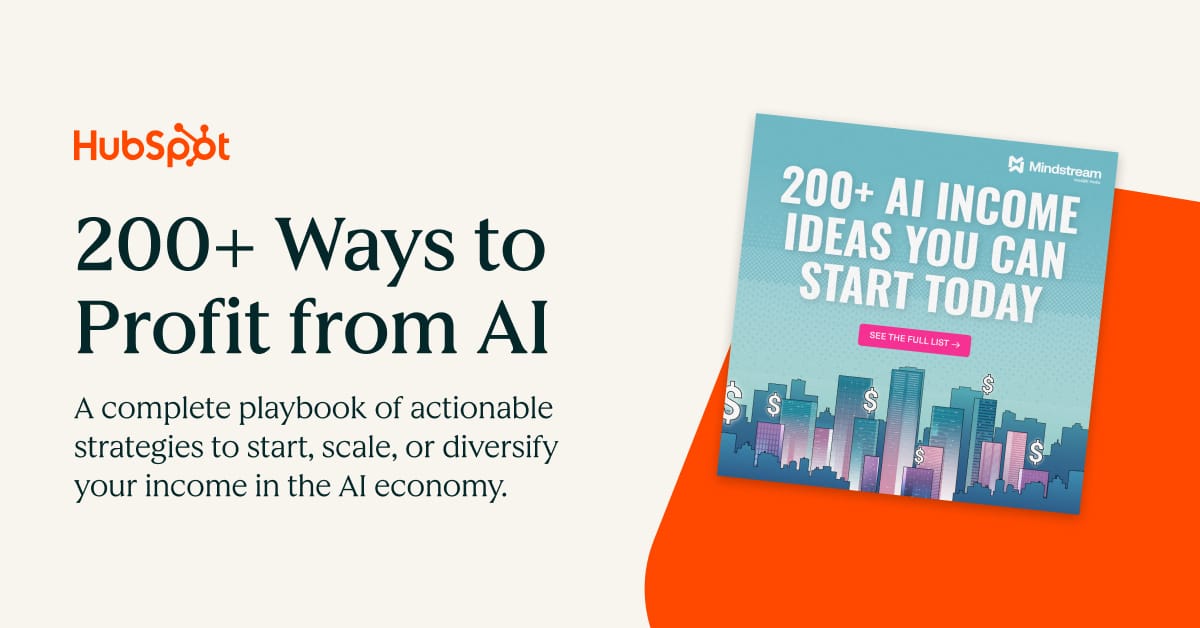
Ready to transform artificial intelligence from a buzzword into your personal revenue generator?
HubSpot’s groundbreaking guide "200+ AI-Powered Income Ideas" is your gateway to financial innovation in the digital age.
Inside you'll discover:
A curated collection of 200+ profitable opportunities spanning content creation, e-commerce, gaming, and emerging digital markets—each vetted for real-world potential
Step-by-step implementation guides designed for beginners, making AI accessible regardless of your technical background
Cutting-edge strategies aligned with current market trends, ensuring your ventures stay ahead of the curve
Download your guide today and unlock a future where artificial intelligence powers your success. Your next income stream is waiting.
Get more involved ❤️
Continue learning 🎓
How to build
How to sell
How to operate:
Other resources 📚
Learn more about the latest trends in startups/tech/venture
Access our crowdsourced Founders’ Prompt Library to build faster
Apply to participate in Founders Pop-up Board Advisory and receive startup feedback from execs at Google, Microsoft, Meta, Reddit
Schedule for a free consultation on structuring your equity-based compensation plan
Fill this form and we’ll get in touch for details on how we can get your brand in front of our community
Kickstart your idea 💡
Still figuring out your startup idea?Take our free course ― Zero to Startup: How to Identify a Winning Idea Fast, where you’ll receive 1 email per day over 5 days to help you get started! |
Help us improve 🌱
What did you think of today's content?Your feedback helps us improve. |
Please complete this 2-min survey to help us get to know you and better tailor content for you.
“Reply” with any follow-up questions you might have, and we’ll work on covering them in a future newsletter!
Stay tuned for more startup wisdom in next week’s edition!